Managing Users and Roles
- Managing Users
- Managing Clinical Information
- Role Descriptions
- Supervision
- Managing Access to Client Records
- Removing a User from your Account
- Frequently Asked Questions
Managing Users
Adding additional users to your Sessions Health account:
Permissions: This feature requires administrator permissions. If you don't have permissions, please contact your account administrator regarding this feature.
- Navigate to the Account Settings page from the left-hand menu and open the Members tab at the top of the page.
- Click + Add Member in the upper right corner of the page to open the Invite a Member pop-up window.
- Enter the member’s email address in the first field shown, then select their role type(s) such as Practitioner, Supervisor, Scheduler, Biller, or a combination based on their access needs.
Note: Sessions Health does not charge an extra fee for supervisor, scheduler, or biller roles added to your account.
- Once the new member’s role(s) are configured, scroll down and click Send Invite. Next, the invitee will receive an email with a link to accept the invitation and set up their account password.
Disabling Billing Features for Practitioners
To disable a practitioner’s billing functions, under the Practitioner Permissions section toggle off the "View/Manage clients’ billing information, documents, and insights" setting.
Doing so will restrict the clinician’s visibility of all billing-related features for their assigned clients, including (but not limited to):
- The Client Billing page
- Billing insights on the Home screen (Clients Pending Bills, Open Bills, Revenue, and Projected Revenue)
- Billing information and reports on the Insights page
- The Billing tab within the client’s record
- The ability to create and manage invoices
Granting Full Clinical Access for Practitioners
By enabling the “Grant full clinical access to all clients within the account” feature, the practitioner gains permission to view and manage all clients’ clinical documentation within the account. When this permission is turned off, the practitioner will only have access to clients for whom they are the assigned practitioner.
Managing Clinical Information
Administrators can add or edit a practitioner’s clinical information at any time. To start:
- Navigate to Account Settings > Members tab.
- Locate the practitioner that needs modifying and click the three dots (⋯) on the right-hand side.
- Select Edit Clinical Information.
- A pop-up window will appear, allowing administrators to update details such as the practitioner's NPI, Taxonomy Code, and Legal Name.
Practitioner Legal Names
This feature allows practitioners to display a preferred name while maintaining a legal name for documentation and billing purposes.
- The preferred name appears throughout the platform, including headers for progress notes and clinical documentation.
- The legal name is used on claim forms and superbills to ensure insurance billing compliance.
To edit a practitioner’s name:
- In the same Edit Clinical Information modal from the previous section, click Add Legal Name.
- Enter the name shown on the practitioner’s professional license, then select Save.
- To remove the legal name, click Remove Legal Name.
Practitioners can also update their own name at any time from this page or under Profile settings, accessible by clicking on their account initials in the top right corner of Sessions Health.
Members List Search and Filtering Options
On the Members page, administrators can also look up users by name or filter the Members list by role type.
To search for a member on the account, you can begin typing their name in the search field located on the upper left-hand side of the Members list. The system will type ahead, providing matches that are available.
To filter your Members list, click on the filter icon found under the + Add Member button. Here, you can click Select All to view the full members list. To filter by a specific role type, deselect the Select All checkbox and check the desired role type box, such as users with the Practitioner role, as shown below.
Role Descriptions
Scheduler Role
Being a scheduler means that this person can manage scheduling for ALL clients and practitioners. Unless the Practitioner role is explicitly granted in addition, this role does not allow access to client notes, diagnoses, or treatment plans. There is no additional charge for users with the Scheduler role. Please see this Scheduler Role video for more details.
Biller Role
Being a biller means that this person can manage bills, billing settings, and view diagnoses for ALL clients. Unless a user is explicitly granted the Practitioner role in addition to the Biller role, they will not be able to view client clinical details such as notes or treatment plans. There is also no additional charge for users with the Biller role. Please see this Biller Role video for more details.
Forms Administrator Role
Being a forms administrator means this member will be able to manage and customize all forms on the account.
Differences between Basic Member and Administrator
Basic members are able to view, manage, schedule, and bill their clients. Administrators can do everything a Basic Member can do, but can additionally manage all other members of the organization, view and set all organization billing settings, view limited client information for every practitioner within the account, and view all historical invoices for the organization. By default, account administrators are automatically assigned the Forms Administrator access.
Daily Digest Notifications for Each Role
The daily digest runs at 6am Central Time and is only sent out when there are important events that have happened in the preceding 24 hours. Depending on a user's assigned role, determines which notifications they'd receive. For guidance on who receives which notifications, please refer to the Daily Digest article.
Supervision
Supervisor Role
A supervisor role can be assigned to a member of the account who will be supervising another practitioner in the same account. This role allows supervisors to access, review, and co-sign their supervisees’ clients’ progress notes and treatment plans.
Note: The supervisor role alone does not incur an additional fee.
To access the supervision features, the Supervisor role must first be assigned. Administrators can add a new supervisor to an account by following the steps outlined under the Managing Users section of this article, then toggling on the Supervisor role button.
If the intended supervisor is an existing member on the account, you can click the three-dot menu on their name panel and select Edit Permissions to assign the Supervisor role, then Save your changes in the bottom-right corner of the modal.
Assigning a Supervisor to a New Practitioner
Once a member with the Supervisor role has accepted the invitation and joined the account, administrators can assign them to a new associate by following this process:
- On the Account Settings > Members page, administrators can click + Add Member to invite a new associate to the account.
- In the Invite a Member pop-up window, enter the supervisee’s email address in the first field. The Practitioner role will be selected by default.
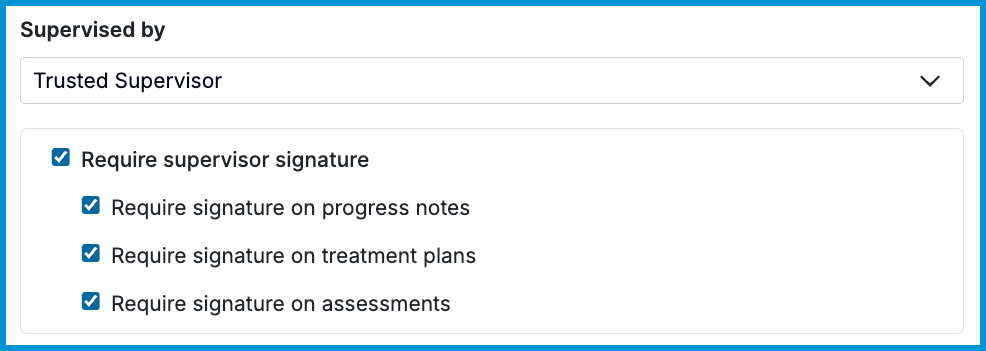
- Scroll to the Supervised By section (located beneath the Practitioner role). Select the assigned supervisor’s name from the drop-down labeled Choose a supervisor...
- Next, you can choose the Require supervisor signature setting to specify whether the supervisor’s signature is required on the supervisee’s progress notes, treatment plans, or both by selecting the corresponding checkboxes. To remove the co-signing requirement entirely, uncheck the Require supervisor signature box.
- Once the preferred selections are finalized, scroll to the bottom of the modal window and click Send Invite.
If a supervisee joined the account without being assigned a supervisor, administrators can click the three-dot menu on the supervisee's name card and select Edit Permissions. In the pop-up window, scroll to the Supervised By section and choose a supervisor from the drop-down menu.
From the Members table, under the Roles column, an administrator can hover over the Supervisee label to see who the associate is supervised by, as shown in the figure below.

Check out our Tutorial Video: Supervision
Managing access to client's records
By default, only the assigned practitioner and administrators can access a client's record. Both the assigned practitioner and administrators may also allow other practitioners access to a client's record. An administrator can manage access for all clients, whereas the assigned practitioner can manage access for only the clients they're assigned to.
To manage access of a client's record, go to Clients > [Client Name] and click the "..." to view the drop-down options. Choose Manage Access to select other practitioners you'd like to grant access to the client's record.
The same three-dot menu can be used to revoke access.

Check out our Tutorial Video: Managing Clients in a Group Practice.
Removing a User from your Account
To remove a person, on the left navigation bar, go to the Account Settings. On the Members page, click the "..." menu next to the person you'd like to delete from the system, then select Remove.
- Warn that supervisees will no longer be under supervision if the practitioner was a supervisor (and had assigned supervisees)
- Warn that future appointments with the practitioner will be removed (if any exist)
- Prompt who should be assigned to the practitioner's assigned clients
- Prompt who should be assigned to the practitioner's incomplete notes (if any exist)
Frequently Asked Questions
Can clinicians manage their client billing without seeing revenue insights on their Home page?
Not at this time. There isn’t a way to customize clinician access to view/billing information, documents, and insights separately.
Can I have more than one supervisor?
At this time, only one supervisor can be assigned to a practitioner at a time. Our team is reviewing the possibility of allowing multiple supervisors to be assigned in the future.
What happens to the data when I remove a practitioner from my account?
If there are any incomplete notes at the time of removal, they will be reassigned to the newly assigned practitioner. However, completed notes will remain under the original practitioner's name, ensuring historical accuracy in records. Revenue reports will also include historical data associated with the removed practitioner.